Cooking Fever: Restaurant Game
- 4.4
- Rating
- 100.00M
- Installs
- Free
- Price

 Analysis by App-foxy
I can open Cooking Fever: Restaurant Game with only a few spare minutes and understand what I am doing almost immediately: prepare orders, serve customers, collect the result, and try to handle the next rush more cleanly. That quick readability is the game’s biggest strength. It feels made for a short break rather than a long, uninterrupted commitment, yet it still gives me enough progression and pressure to make another attempt tempting.
Developed by Nordcurrent Games, this free arcade game has built a remarkably large audience since its release on February 25, 2015. Its average rating is 4.4 from around 5 million ratings, and it has passed 100 million installs. Those figures do not automatically make a game good, but they fit my experience: this is an accessible, easy-to-start cooking title that explains its basic appeal without demanding a tutorial marathon.
Why the first few minutes work so well
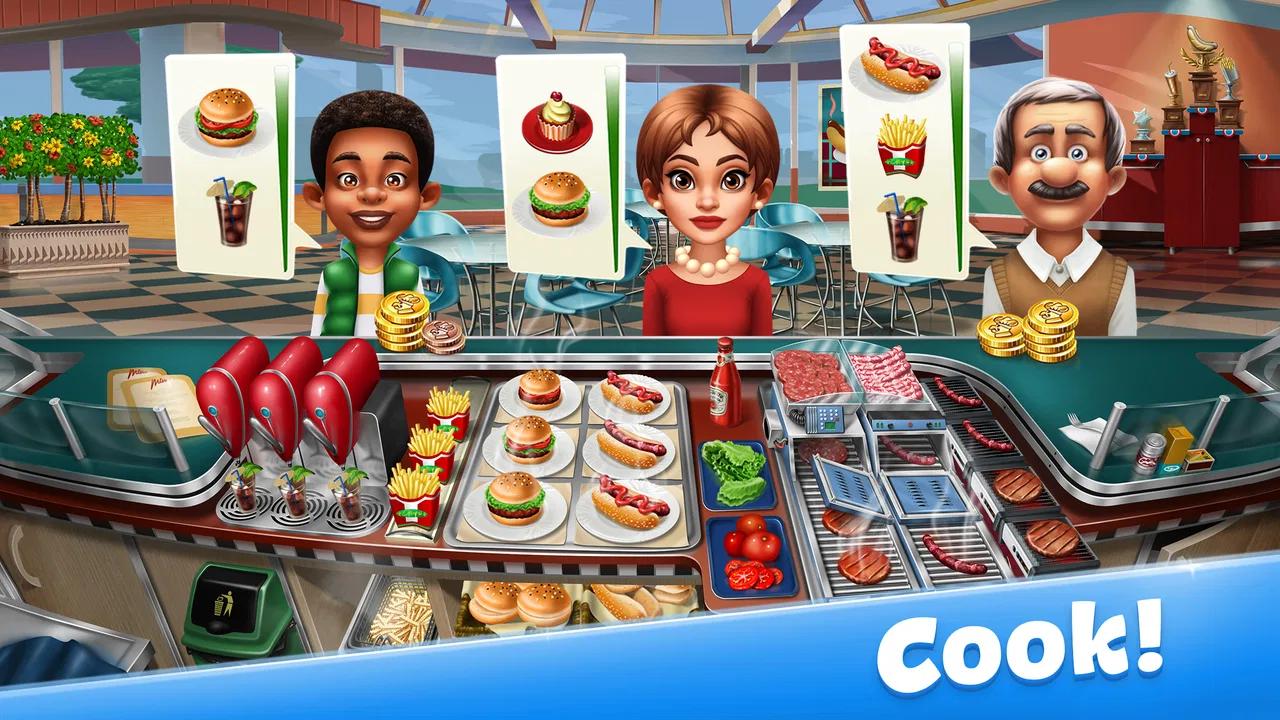
The attraction is not culinary realism. I am not learning recipes or managing a believable restaurant. Instead, the game turns cooking into a fast sequence of visual priorities. Orders appear, appliances and prepared items compete for my attention, and customers create a moving checklist. I can usually recognize the urgent task at a glance, which makes every successful serving feel immediate.
You May Also Like

 Blood Strike: 2.5 Anniversary
Blood Strike’s Loadouts Turn Every Drop Into a Tactical Gamble
A close look at Blood Strike’s custom loadouts: how fast access to signature weapons reshapes its battle royale rhythm, rewards preparation, and narrows the gap between fights.

 Pandora - Music & Podcasts
Pandora’s Music Is Easy to Start, but Harder to Recover
Pandora’s strength is its low-effort path from a seed to a station. Its weak spot is how much confidence it asks you to place in connection, setup, and quiet recovery.

 8 Ball Pool
 Is Built on Rivalries, Rematches, and Routine
A close look at the rivalries, rematches, shared routines, and unanswered safety questions that turn a quick pool match into a persistent mobile community.

 Samsung Music
’s Quiet Strength Is Playing What You Already Own
Its reach comes less from spectacle than from dependable access to a personal library. That simplicity is both the app’s strongest retention engine and its ceiling.

 AccuWeather: Weather Radar
AccuWeather Review: A Quick, Clear Forecast for Everyday Decisions
For everyday plans, the best forecast is the one you can understand quickly. AccuWeather makes rain timing, radar, and local conditions easy to act on, with a few trade-offs.

 Hill Climb Racing
Why Hill Climb Racing Still Turns Crashes Into One More Run
A tiny car, a bumpy hill and one more upgrade: Hill Climb Racing keeps resurfacing because its simple chaos makes every near-miss feel personal.
More From Our News Desk



That instant hook matters on a phone. Many arcade games need several minutes before their central idea becomes enjoyable, while this one gives me a clear objective almost at once. The satisfaction comes from keeping several small actions under control. I may start by serving one customer comfortably, then find myself preparing one item while watching another, collecting earnings, and deciding which improvement will help the next round.
The presentation also keeps the mood light. The food and restaurant settings are colorful, and the tone avoids turning mistakes into something punishing or gloomy. For me, that makes it easy to recommend to someone who wants a cheerful time-killer rather than an intense action game. The Everyone age rating also matches the approachable presentation.
There is a useful distinction between this and a restaurant-management simulation. I am not spending most of my time studying menus, staffing, inventory, or finances. The emphasis is on quick hands and quick decisions. If you want a detailed business sandbox, this will feel too simplified. If you want a game that lets you feel busy within seconds, that simplicity is exactly why it works.
A session has a clear beginning, middle, and end
Each play session benefits from a straightforward rhythm. I begin by looking at the incoming orders, move into a period of overlapping preparation and serving, and finish by seeing whether my performance was good enough to move forward. That structure makes the game easy to fit around everyday interruptions. I do not need to remember a complicated story or reconstruct a large strategic plan after putting the phone down.
The strongest moments arrive when the restaurant becomes just busy enough to test my attention. At a relaxed pace, I can serve customers almost automatically. When several requests arrive close together, the game becomes a small prioritization puzzle. I have to notice what is ready, what is about to burn or be delayed, and which customer can be handled quickly before attention shifts elsewhere.
One practical habit improved my results: I stopped treating every order as equally urgent. I first look for actions that can run while I serve someone else, then I clear the order that reduces the most immediate pressure. That approach is more reliable than simply tapping the newest customer. It also gives the game a little more depth than its bright, casual appearance suggests.
Upgrades add another layer to the rhythm. Rather than spending progress without a plan, I prefer to improve the part of the restaurant that causes repeated bottlenecks. If a dish takes too long, improving preparation can make the whole round calmer. If customers are leaving unhappy because service is slow, a serving-related improvement may be more valuable. The best purchase is not always the most attractive-looking one; it is the one that removes the mistake I keep making.
This is one of the game’s less obvious strengths: upgrades can change how a level feels, not merely make the numbers larger. A difficult stage may become manageable when I target its main delay. That gives replay value to earlier content because I can return with a better setup and a cleaner strategy instead of simply hoping to tap faster.
Short breaks, interruptions, and returning later
The game is particularly comfortable when I have a small, uncertain window of time. I can play during a coffee break, while waiting for an appointment, or at the end of the day when I do not want to begin something demanding. The individual rounds are compact enough to feel purposeful, but they do not require the emotional investment of a long campaign.
Its pause-and-return quality is more important than it first appears. A game designed around short sessions should let me come back without feeling lost, and this one generally does that through its simple goals and repeated structure. I can remember the basic flow immediately: enter a level, watch the orders, prepare efficiently, and use the reward to improve future attempts.
Still, I would not call every moment interruption-proof. If I leave during a busy round, I may return with the order queue and timing pressure already difficult to reconstruct. That is not a serious flaw for a game of this type, but it means I prefer starting a fresh stage when I know I might be interrupted. The game is forgiving at the level of overall progress, yet an individual rush still depends on concentration.
For a realistic everyday scenario, I would use it while waiting for a train or sitting in a short queue. I can play one round, stop when my turn arrives, and return later without needing to remember a plot twist or a long chain of objectives. It also works after a tiring workday because the first decision is obvious. The trade-off is that the same clarity can become repetitive if I play for a long stretch.
Players who dislike energy systems, purchase prompts, or any free-to-play friction should approach with patience. The game is free to download and play, but optional in-app purchases range from $0.99 to $130.00 per item. I would not recommend spending impulsively just to get past a frustrating level. A better approach is to treat purchases as entirely optional and first see whether ordinary play, careful upgrades, and a break from the stage are enough.
Where the replay value comes from
Cooking Fever does not rely on one clever idea that stays fresh forever. Its replay value comes from combining familiar actions with changing pressure. I return because I want to improve a result, unlock or handle the next challenge, or test whether a different upgrade order makes a troublesome restaurant smoother. That is a modest form of replay value, but it suits the arcade category well.
The repetition is also the central limitation. Preparing, serving, collecting, and upgrading can begin to feel like a loop rather than a constantly evolving game. Players who need deep character development, complex construction, or a large variety of control styles may run out of interest. I enjoy the loop most when I play in short bursts; in a long sitting, I notice its patterns much more clearly.
My best strategy for avoiding fatigue is to stop after a satisfying improvement instead of continuing until every round feels like work. If I finally solve a stage that had been causing trouble, that is a natural stopping point. Returning later makes the familiar structure feel useful again, while forcing several more rounds immediately can expose the repetition.
Another helpful habit is to distinguish between a genuinely difficult level and a poorly prepared one. When a stage repeatedly collapses at the same moment, I look at the bottleneck before blaming my reflexes. Sometimes I am spending attention on the wrong order; sometimes an upgrade would remove the delay; sometimes I am simply playing too long and making avoidable taps. That small diagnostic step makes progress feel earned rather than random.
Compared with match-three games, this offers more active multitasking and less dependence on finding a lucky combination. Compared with idle restaurant games, it asks me to participate rather than wait for income to accumulate. Compared with serious cooking simulators, it is faster, brighter, and far less concerned with authentic technique. I would choose it when I want direct interaction and quick feedback, not when I want a realistic kitchen or a relaxing game with almost no pressure.
Who will enjoy it, and who should skip it
I think it is a strong match for casual players who like visible goals, quick rounds, and a steady sense of improvement. It is also suitable for someone new to mobile games because the controls and objectives are easy to grasp. The arcade classification is accurate: the pleasure comes from timing, attention, and repeating a task until the result becomes cleaner.
It is less suitable for anyone who wants a fully calm experience. Although the colorful style looks relaxing, busy levels can become surprisingly demanding. It is also not ideal for players who dislike repeating a stage after a small mistake, or for those who want every session to introduce a fundamentally new mechanic. The game’s appeal depends on finding satisfaction in refinement.
I would also skip it if my main goal were learning to cook. The food theme is a playful setting for an arcade challenge, not practical instruction. Likewise, someone looking for a multiplayer restaurant experience should choose a game built around direct cooperation or competition instead. This title works best as a solo, self-paced challenge where my own previous performance is the main opponent.
The current version is 26.0.1, and the game requires at least OS 9. That makes it worth checking device compatibility before installing, especially on an older phone or tablet. Once running, it is the kind of title I can understand without reading a long manual, which is a meaningful advantage for occasional players.
My casual verdict after living with the loop
What I like most is the immediate pleasure. I can open the game, recognize the task, and get a small burst of concentration without preparing for a major session. The restaurant theme gives the tapping and timing a friendly context, while the upgrade choices provide enough direction to make repeated attempts worthwhile.
What holds it back is the same thing that makes it approachable: the core loop remains familiar. The game can entertain me repeatedly, but it does not disguise repetition as something completely different. Free-to-play purchase options may also create friction for players who prefer a single upfront price and no temptation to accelerate progress.
My recommendation is simple: try it if you want a short-session arcade game with clear goals and satisfying multitasking. Play in brief bursts, spend upgrades on the bottlenecks that actually slow you down, and do not feel pressured to continue when a level stops being fun. Choose another option if you want realistic cooking, deep management, multiplayer interaction, or a completely interruption-free experience.
For me, Nordcurrent Games has made a dependable mobile time-killer rather than an endlessly surprising masterpiece. Its 100M-plus installs and strong player response make sense because the design is welcoming, readable, and easy to return to. I would keep it available for waiting rooms and short breaks, especially when I want a little activity instead of passive scrolling. It succeeds by making a few spare minutes feel like a complete game session.
FAQs for Cooking Fever: Restaurant Game
01What is Cooking Fever: Restaurant Game all about?
Cooking Fever: Restaurant Game is a time-management game where players can manage various virtual restaurants. The game involves preparing dishes, serving customers, and upgrading kitchen equipment. With over 1,000 levels, it provides diverse cuisines and restaurant themes, making it engaging for both casual and dedicated gamers.
02Is Cooking Fever free to play or are there in-app purchases?
Cooking Fever is free to download and play. However, it includes in-app purchases that allow players to acquire gems and coins. These can be used to speed up progress, unlock new levels, or purchase special upgrades. Players can enjoy the game without purchases, but it may require more time and effort.
03What platforms support Cooking Fever: Restaurant Game?
Cooking Fever is available on both Android and iOS platforms. It can be downloaded directly from the Google Play Store for Android devices and the Apple App Store for iOS devices. The game requires a stable internet connection to access all features and updates effectively.
04How does Cooking Fever handle user privacy and data?
Cooking Fever collects data necessary for gameplay and user account management. It follows standard privacy policies, ensuring data protection and user consent. Players are encouraged to review the privacy policy in the app settings to understand how their data is used and managed.
05Can Cooking Fever be played offline?
Cooking Fever requires an internet connection for certain features like syncing progress and accessing updates. However, some basic gameplay can be enjoyed offline. To fully experience the game and keep progress saved across devices, staying online is recommended.
Pros
- Engaging gameplay with diverse cuisines.
- Frequent updates add new levels.
- Intuitive controls and user-friendly UI.
- Offline mode available for play anywhere.
- Visually appealing graphics and design.
Cons
- Can become repetitive over time.
- In-app purchases can be costly.
- Requires internet for some features.
- Progression can be slow without spending.
- High storage space requirement.

Cooking Fever: Restaurant Game
Gallery